
Disclosure: This guide contains affiliate links to PracHub. If you buy a Premium subscription through one of these links, we earn a commission at no extra cost to you.
You have an interview lined up at your dream company, say Stripe, Google, or OpenAI. Now comes the real question: what does the company actually test? General interview prep with LeetCode and standard questions is not enough if you do not know how many rounds there are, which formats come up, and what the company weighs most heavily.
Company-specific preparation does not mean guessing what will be asked. It means knowing the process, being able to place the typical topics in context, and spending your limited prep time where it pays off most. This guide shows you how to get that information and turn it into a concrete plan.
One thing upfront: this guide does not replace foundational preparation for algorithms, system design, or behavioral interviews. We link to our detailed guides on those topics where relevant. Here we focus exclusively on how you find out what a specific company expects from you, and how you use that information.
Step 1: Research the company’s interview process
Before you practice a single question, clarify the process. How many rounds are there? Which formats come up, coding, system design, behavioral, take-home? How long does each round run, and what does it evaluate?
The most reliable source for that is your recruiter. At larger tech companies it is completely normal to ask for an overview of the rounds. A short line like “Could you tell me which rounds are part of the process and what each one focuses on?” usually gets you further than any amount of research online. Many recruiters will even send prep material or a list of topics if you ask.
It also pays to check the company’s careers page and engineering blog. Larger companies often describe their interview process there in broad strokes, sometimes with sample tasks or evaluation criteria.
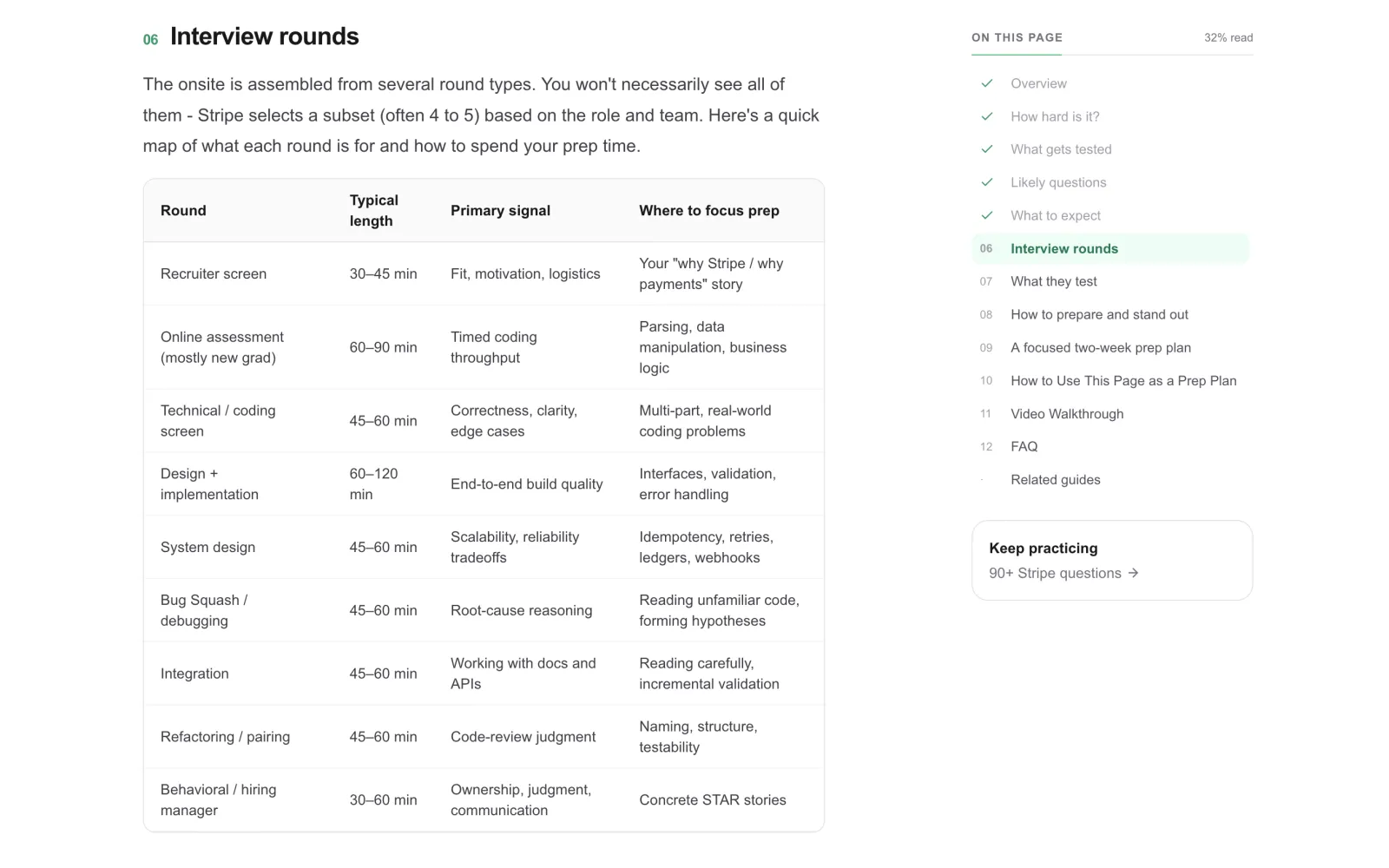
Stripe is a good example. Alongside classic coding rounds, the process includes a “Bug Squash” round where you find defects in unfamiliar code, and an Integration Round with practical API tasks. If you have never heard of these formats, you walk into some of the more unusual parts of the process unprepared. You only get details like these through targeted research, not generic interview training.
Other companies have similarly specific quirks. Some system design rounds at larger platforms focus explicitly on scaling and cost trade-offs rather than pure architecture. Some behavioral rounds are tightly coupled to internal company principles, as is the case with Amazon’s Leadership Principles. Without that context, a technically correct answer can miss the actual evaluation criteria.
Step 2: Where to find real interview questions
Once you know the process, it is time for content prep. Several sources give you questions and experience reports, each with their own strengths and weaknesses.
Glassdoor
Glassdoor collects interview experiences from users, often with concrete questions and ratings of the process. The upside is the sheer volume of reports for large companies, often spanning years, so you can see how a process has changed over time. The downside: quality varies a lot, many entries are short or outdated, and filtering by role and round is limited. For smaller companies or startups you often find only a handful of reports.
Blind
Blind is an anonymous forum for tech employees and works well for current, unfiltered opinions about companies and sometimes about interview processes. Discussions are more direct than on Glassdoor, but less structured. You have to search for relevant threads yourself, there is no systematic question bank. The upside: because the forum is anonymous and insider-driven, you sometimes get more honest takes on the actual interview culture of a company, not just individual questions.
Official recruiter prep material
As described in step 1: actively ask for it. This is the most reliable source because it comes directly from the company, but it usually covers only the broad process, not individual questions. Some recruiters will even send a PDF with topic areas or sample tasks, especially at larger tech companies with standardized processes. The downside: smaller companies or startups often have no prepared material, and you get at most a verbal summary.
LeetCode company tags (Premium)
LeetCode lets you filter problems by company when users have tagged them accordingly. That is useful for focusing on algorithm patterns that come up more often at a specific company, for example if a company is known for asking a lot of graph or dynamic programming problems. The feature is part of LeetCode Premium and tells you nothing about rounds, behavioral questions, or system design. It is a pure complement to coding practice, not a substitute for researching the overall process.
PracHub
PracHub bundles interview questions from candidate reports and lets you filter by company, role, round, and difficulty. For more than 770 companies it also has structured guides with topic breakdowns, likely questions, and a round overview, similar to the Stripe example above. That saves you time compared to digging through forums, because the information is already organized.
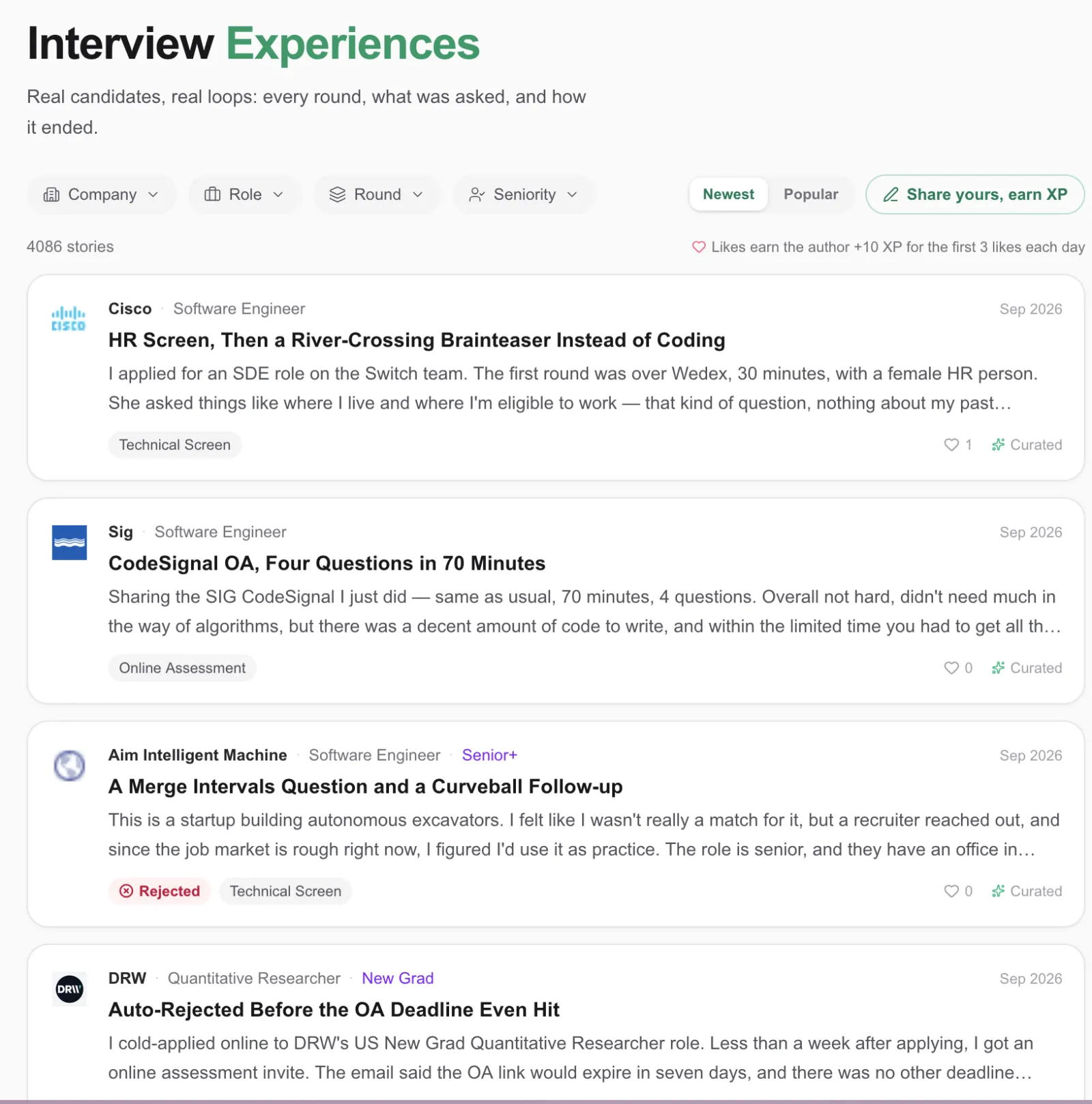
For more on how good PracHub actually is, what it costs, and where its limits are, read our full review.
Quick summary per source: Glassdoor gives you volume, Blind gives you unfiltered sentiment, your recruiter gives you the most reliable structural data, LeetCode gives you algorithm patterns, PracHub gives you organized questions and guides. Combining several sources beats relying on just one.
How much can you trust leaked questions
This is the most important question for any research like this: no company officially publishes its interview questions. Everything you find on Glassdoor, Blind, or specialized platforms comes from individual candidate reports and is sometimes edited or rewritten.
A few rules of thumb help you judge reliability:
- Check the date. Interview processes change. A question from a two-year-old report tells you less about the current process than one from the last few months.
- Check the role and round. A question from a senior interview will not help much if you are applying for a junior role, even at the same company.
- Cross-check across sources. If a topic or format shows up in several independent reports, it is more likely to be a real pattern rather than a one-off.
- Expect rewrites. Many questions read more like polished practice tasks than something an interviewer said word for word.
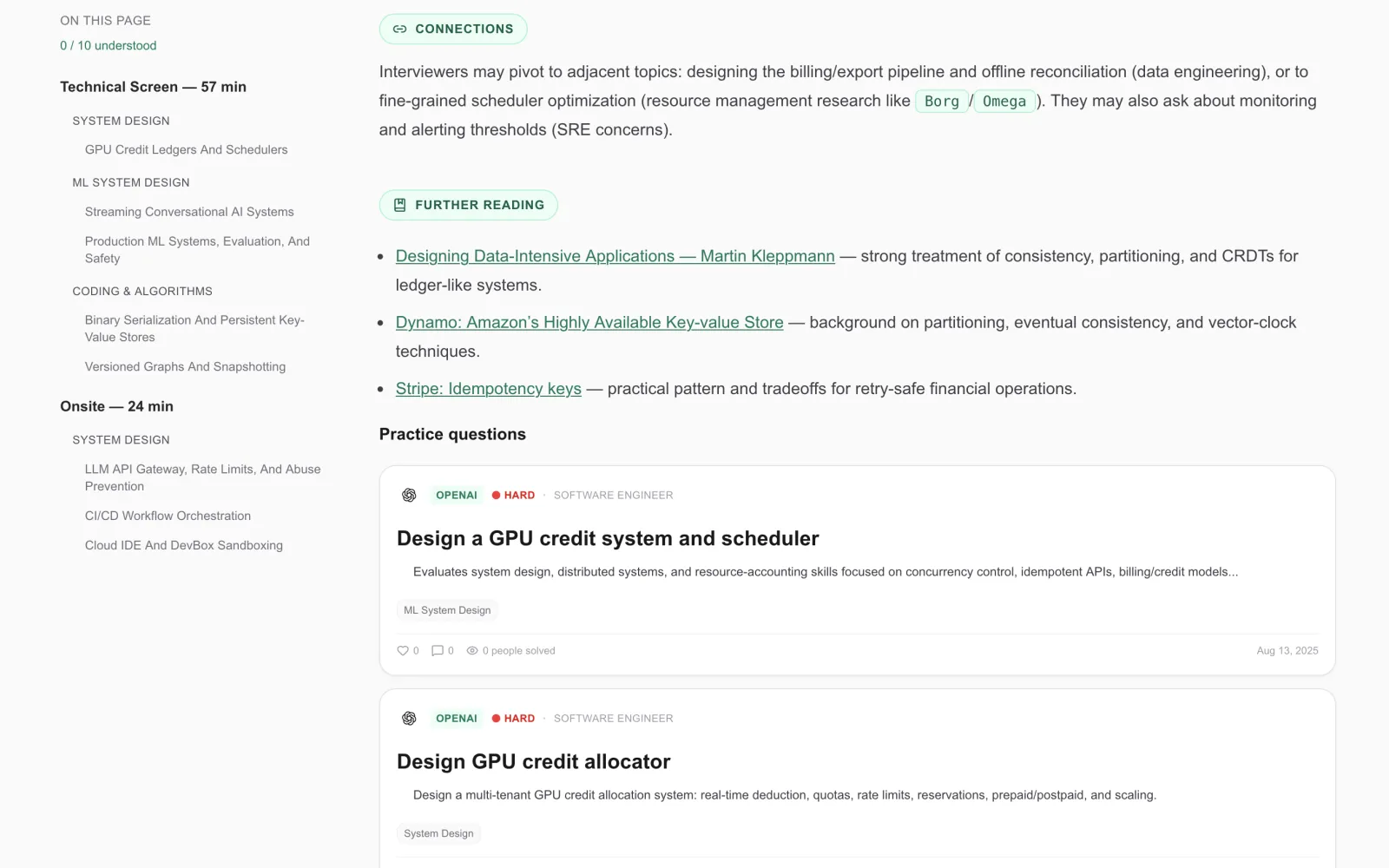
The practical takeaway: use leaked questions to understand which topics and formats a company tests, not to memorize an exact answer to an exact question. The most reliable way to learn about your own specific process remains your recruiter.
Your 2-4 week plan for your dream company
With the information from steps 1 and 2, you can allocate your remaining prep time deliberately. The plan below assumes two to four weeks until the interview and that you already have solid algorithm fundamentals.
Week 1: Research and gap analysis. Clarify the process with your recruiter, gather questions and guides for your target company through the sources above, and compare that with your current knowledge. Where are your biggest gaps, maybe a specific system design topic or an unfamiliar round format?
Week 2: Coding and format-specific practice. Practice tasks that match the company’s profile, for example through LeetCode company tags or PracHub’s question bank. For unusual formats like a bug squash round, practice debugging unfamiliar code specifically, not just writing your own. For the general coding patterns, our FAANG interview preparation guide helps.
Week 3: System design and behavioral, tailored to the company. If the company is known for specific values or principles, such as Amazon’s Leadership Principles, prepare your stories accordingly. Our complete guide on that is Amazon Interview in Germany. For system design in general, FAANG Interview Prep: The Complete Guide gives you a structured roadmap.
Week 4: Mock interviews and review. Simulate the actual process as closely as possible, including time pressure and the company’s specific round formats. For an overview of mock interview options, from free peer platforms to professional coaching, see Mock Interview Online: Free Tools, AI, Coaching.
If you only have two weeks instead of four, compress the plan: research and gap analysis on days 1 to 3, coding and format training in week 1, system design, behavioral, and at least one mock interview in week 2. What you should not cut is the recruiter contact from step 1 and at least one realistic simulation before the real interview. Both give you the biggest return per hour invested.
Common mistakes
- Only practicing generically. If you solve random LeetCode problems without knowing your target company’s process, you waste time on topics that never come up in the actual rounds.
- Fixating on individual leaked questions. Memorizing an exact answer instead of understanding the underlying concept leaves you exposed to slightly different variations.
- Not asking the recruiter about the process. This information is often available for free and yet rarely actively requested.
- Ignoring unusual round formats. Formats like bug squash or take-home rounds get overlooked because they do not match the standard coding interview.
- Not scheduling time for mock interviews. Content knowledge alone is not enough if you cannot communicate clearly under time pressure.
- Relying on a single source. If you only use Glassdoor or only a platform like PracHub, you get an incomplete picture. Cross-checking multiple sources is what shows you which patterns are actually stable.
- Starting company-specific prep too late. If you only start researching a few days before the interview, you no longer have time to close gaps deliberately, and end up practicing whatever you happen to come across first.
Verdict
Company-specific preparation means spending your limited time where it makes the biggest difference: knowing the process, the formats, and the focus areas of your target company. Your recruiter is the most reliable source for that, complemented by platforms like Glassdoor, Blind, LeetCode, and PracHub for context and practice. None of these sources fully replaces the others, but together they give you a much clearer picture than relying on generic training alone.
If you then want to test how you perform under real time pressure with real feedback, our coaches can help. At CodingCareer, former FAANG interviewers run realistic mock interviews in English and German, tailored to your target company’s process. Learn more about our FAANG coaching.
FAQ
Where can I find real interview questions for a company?
The most reliable source is your recruiter: ask directly for an overview of the rounds. On top of that, check Glassdoor, Blind, the company's careers page and engineering blog, and specialized platforms like PracHub, which collect questions from candidate reports and let you filter by company, role and round.
Am I allowed to ask the recruiter about the process?
Yes, that is standard practice at larger tech companies. Recruiters expect this question and will usually give you an overview of the rounds, sometimes even prep material. Ask specifically about the number and type of rounds, not for the exact questions.
How reliable are leaked interview questions?
It varies. No company officially publishes its questions, everything comes from candidate reports and is often rewritten or expanded. Use leaked questions as a signal for topics and formats, not as a script that will come back word for word. Check the date, role and round, and cross-check important details across several sources.
How long should I prepare for a specific company?
For a concrete interview in the next few weeks, 2 to 4 weeks of focused preparation is usually enough, assuming your algorithm and system design fundamentals are already solid. Without those fundamentals, you need extra time for general preparation before company-specific training pays off.
Is LeetCode enough for company-specific preparation?
No. LeetCode trains algorithm patterns, but it tells you nothing about the process, the number of rounds, or the focus areas of a specific company. Combine algorithm training with company-specific research into format and topics, otherwise you walk into rounds that look very different from what you expected.